- The Financial Brain
- Posts
- 🧠 How many ETFs do you really need?
🧠 How many ETFs do you really need?
10 ETFs or 3? Here's what really matters.

Nessrine Slimani
January 29, 2026
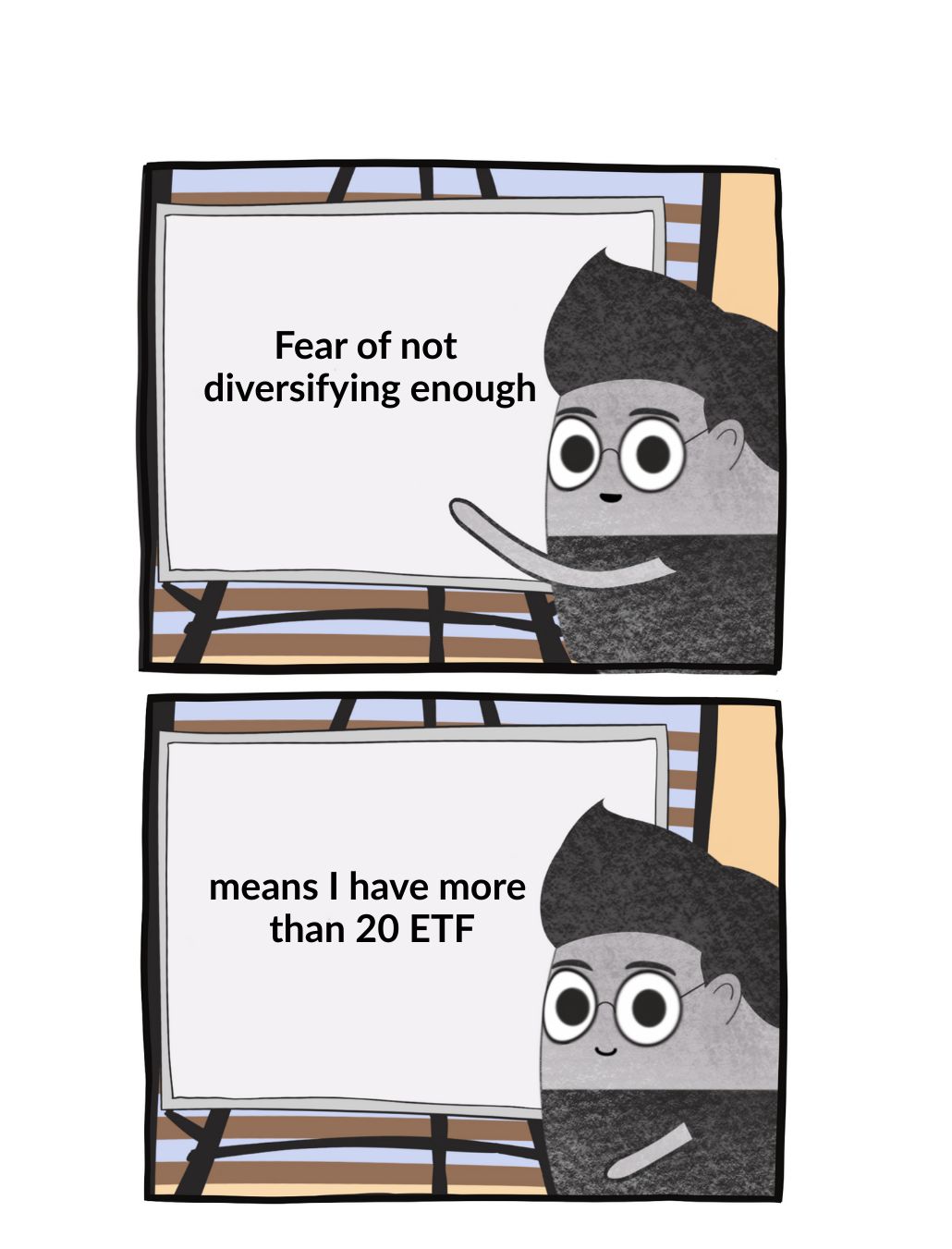
Some good intentions lead to self-sabotage.
Especially when it comes to diversification.
Recently, a reader asked for my opinion on his portfolio:
9 different ETFs, with quite a lot of overlap.
A few months ago, a friend asked me to look at the recommendations from her robo-advisor: 14 funds, again with lots of overlap.
Yes, it's important to diversify your investments to avoid big losses when markets fall, but:
When does complexity stop adding value?
Is there an optimal number of positions to have in a portfolio?
What role does asset class play in the number of positions?
In short: is there an ideal number of ETFs to be truly diversified?
Why do people recommend 20 stock positions?
The general recommendation is to hold 20 to 30 positions when investing in individual stocks. Why?
Because each stock is exposure to a single company. If that company faces ongoing difficulties and doesn't recover, you risk losing everything on that position.
That's where the risk is huge.
The idea behind 20-30 stocks is that if one position collapses, the others (if well chosen) can make up for it. Statman's 1987 study shows that around this threshold , the specific risk for each company is largely reduced.
What about ETFs, is it the same?
With an ETF, it's not the same thing.
Quick reminder: an ETF is a fund that's listed on the stock exchange. ETFs contain multiple stocks and can easily be bought and sold through your broker or bank.
If the ETF tracks and follows a stock market index, it contains dozens, hundreds, or even thousands of companies, depending on the index tracked.
The MSCI World index?
Around 1,500 companies.
The Eurostoxx 600 index?
Around 600 companies.
The individual bankruptcy risk is already neutralised in the ETF.*
That's why the classic recommendations on the number of positions for stock-picking don't apply to index ETFs.
With a single broad ETF, you already have the diversification that 20-30 individual stocks try to achieve. And much more besides.
**A neutralised risk doesn't mean there are no risks at all.
So what really matters?
So if a single broad ETF is enough for diversification within stocks, why do some portfolios end up with 10 ETFs or more?
Often because people want to do the right thing: they hear everywhere that diversification is important, so they add more positions.
And that’s how you might end up with duplicates without realising it.
Whether it's an ETF or a regular fund, always ask yourself:
Which companies are tracked? Large ones? Small ones?
In which regions?
In a specific sector?
Does the fund follow a trend or theme?
And most importantly:
1. Is it relevant for me to hold this fund?
2. In what proportion?
3. Does it overlap with what I already have?
Some examples of geographical overlap:
If I choose an MSCI World ETF, currently exposed to ~70% US stocks, do I really want an S&P 500 ETF on top?
If I have an Emerging Markets ETF with ~30% exposure to China, do I really want a China ETF as well?
Some examples of sector overlap:
If my ETF already contains lots of companies in healthcare and pharmaceuticals, do I really want a Healthcare ETF on top?
If I already have significant exposure to financial companies in my ETF, do I really want a Finance ETF that doubles this exposure?
These overlaps can be deliberate choices if you have a strong conviction about a region or sector.
But it needs to be conscious and limited to avoid paying fees that make you hold the same companies multiple times.
What about you, how many ETFs do you have in your portfolio?
Do you have conscious or unintentional overlaps?
Feel free to reply directly to this email, I read all responses 🙂
Take care,
Nessrine
Where are you with today's topic? |
Articles, research and studies consulted for this edition:
Important reminder: This content is for educational purposes only, not investment advice. Please do your own research before getting started. And remember that all investments, ETFs included, carry risks of capital loss.
Reply